


Das ist mein zweites Schmuckstück von diesem Shop und ich bin sehr zufrieden. Die Opale sind wunderschön und passen farblich sehr gut zusammen, außerdem ist dieser Silberring verstellbar was mir sehr gut gefällt!




Max, Marie and 3,400 other customers are delighted
925 silver | Australian opal on a black base (doublet)
Tax included. Shipping calculated at checkout
Only 4 left
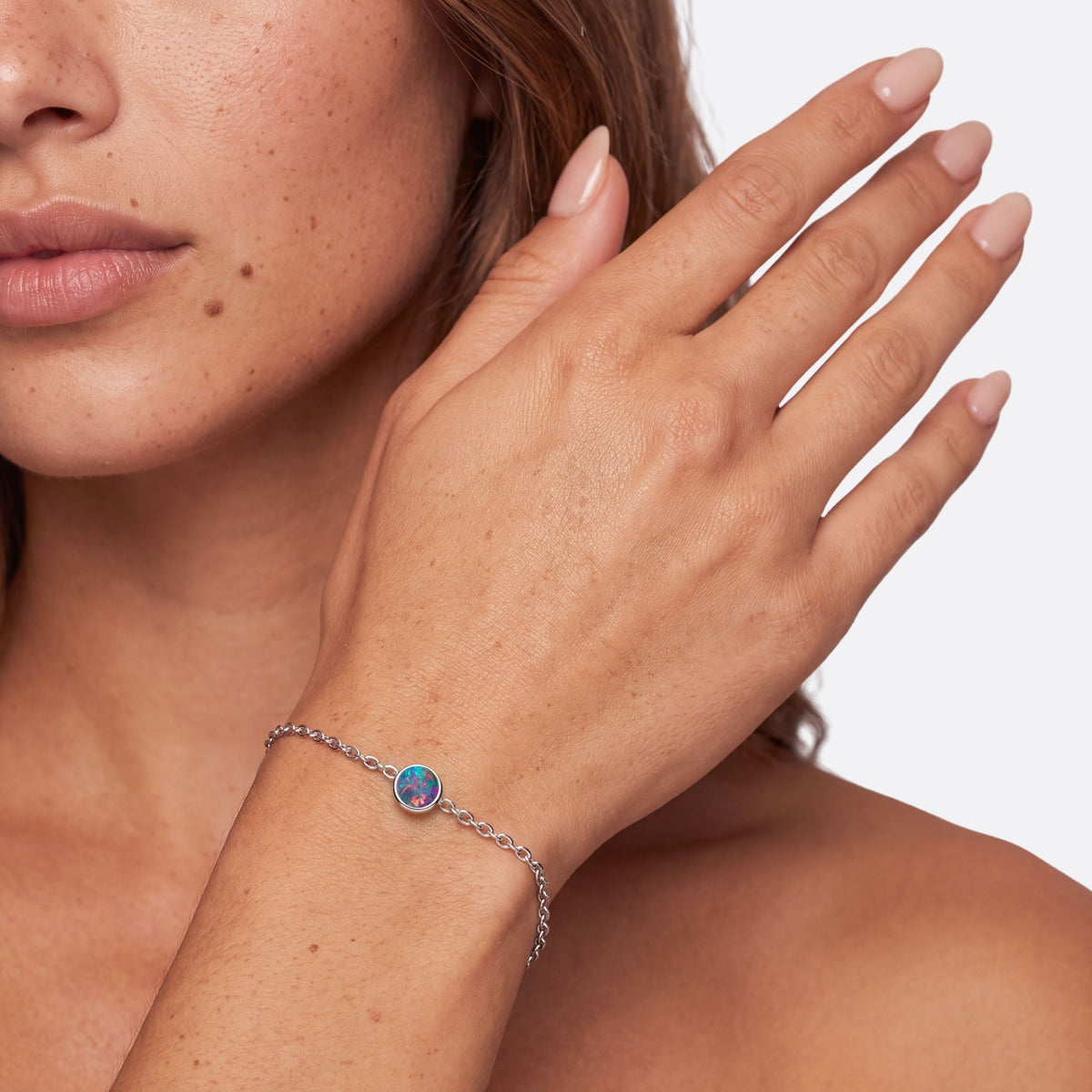
The dark backing behind the stone brings blue, green and the red flashes right to the front. This opal bracelet shows the stone in a new way with every movement of your hand. Genuine opal from Australia, not glass and not a synthetic stone. A gift for someone who has everything but this.
Solid opal. The stone is solid opal, all the way through.
Doublet. A thin layer of opal sits on a dark backing. The dark ground makes the play-of-color deeper and stronger.
Triplet. Like the doublet, with an added clear protective layer on top.
Need it sooner? Call or write to us. We will find a way.
For us, size is the inner circumference in millimetres. Size 54 means the ring measures 54 mm inside.
With a ring that fits: lay it on a ruler and measure the inner diameter.
With a paper strip: wrap it snugly around the finger and mark the overlap. The length in millimetres is the size.
Measure in the evening at room temperature. Fingers are slimmer in the morning and in the cold. The ring has to pass the knuckle.
We carry 38 to 69, and some rings are adjustable.
Size unknown? Then choose a necklace or studs. Both always fit. And we exchange the size within 30 days.
The length is on every necklace in the Details and measurements tab. As a guide: 40–42 cm sits close to the neck, 45 cm falls just below the collarbone, from 50 cm the necklace sits over the neckline.
Studs and hoops do not need a size.
Unsure about size, length or the stone? Write to us. On working days we usually answer the same day.
cs@faerelli.com
If you are buying a gift and do not know the ring size: a necklace or studs always fit. And if it should still be a ring, we exchange the size within 30 days.
Every piece arrives in our gift packaging, at no extra cost, ready to hand over.
On request, as well:
You set all of this in the cart, in one step for the whole order.
Choose options
Overall rating: 4.9 / 5 from 38 reviews.
Das ist mein zweites Schmuckstück von diesem Shop und ich bin sehr zufrieden. Die Opale sind wunderschön und passen farblich sehr gut zusammen, außerdem ist dieser Silberring verstellbar was mir sehr gut gefällt!
die Ohringe sind recht stark unterschiedlich, einer ist deutlich milchiger als der andere.
´
Die Lieferung hat zwar in die Länge gezogen, aber das Ergebnis kann sich sehen lassen.
Ganz tolle Ware. Sehr gut verarbeitet. Schneller Versand
Genau wie in verkauf Bilder
Super schöne Ohrringe ich bin begeistert. Wird nicht mein letzter Kauf bei euch sein.
Gut verarbeitet und sehen hochwertig aus
Das Armband ist hochwertig verarbeitet. Alleine kriege ich den feinen Verschluss mit meinen langen Fingernägeln aber kaum zu und brauche immer Hilfe. Der Schmuck an sich ist top.
Schnelle Lieferung und tolles Aussehen
Schöner Ring und liebevolle Verpackung.
Super als Geschenk geeignet. Danke, weiter so!
So ein Feuer im Opal hab ich noch nie gesehen. Ich bestelle wieder.
Bei Problemen mit dem Versanddienstleister wurde umgehend geholfen. Das Armband ist einfach wunderschön - ich bin sehr zufrieden und werde wieder bestellen.
Top-Geschenk
Ich werde oft auf den Ring angesprochen. Und er sieht wunderschön aus. Danke.
Ich liebe das Armband, weiter so!
Ich habe den Anhänger für meine Frau bestellt, Wunderschön verpackt, mit Wachs-Siegel sogar! Vielen Dank für dieses besondere Stück!
Zum 21. Hochzeitstag perfekt geeignet. Meine Frau ist glücklich.
Perfekt verpackt und rechtzeitig angekommen, Kam in einer kleinen, eleganten Schachtel. Werde ich sofort wieder kaufen.
Immer wieder toll!!!
Ich trage es jeden Tag – es passt einfach zu allem. Würde ich sofort wieder kaufen.
Wunderschöner Ring und tolles Farbspiel. Schöner Versand und wundervoll verpackt.
Ich war skeptisch, aber die Kette hat mich überzeugt! So liebevoll eingepackt, da merkt man die Liebe zum Detail. Der Stein ist einzigartig und schimmert je nach Licht.
Wirklich ein schöner Opal. Eine gute Adresse für schönen Schmuck. Zunächst gab es Probleme beim übersenden des Zertifikats. Mir wurde schnell geholfen und es wurden direkt auf meine Fragen eingegangen. Top 👍
Ein Geburtstagsgeschenk für meine Schwester, sehr hübsch und schön verpackt
Der Stein ist einzigartig und schimmert je nach Licht.
Mein erster echter Opalring. Und gleich ein Volltreffer.
Sehr schöne Ohrringe! Meine Frau liebt Sie.
Den Ring habe ich zum 21. Hochzeitstag meiner Frau geschenkt. Und sie trägt ihn seitdem täglich.
Ein wunderschönes Schmuckstück.
Das Armband war ein Geschenk für meine Frau zur Geburt unserer Tochter. Ich wollte etwas Symbolisches – etwas mit Bedeutung. Der Opal in diesem Armband fängt irgendwie all das ein, was ich ihr sagen wollte: Liebe, Wandel, Tiefe. Verpackung top, Service super freundlich. Danke!
Ich habe meiner Freundin die Opal-Ohrringe von Liberty Angels zum Geburtstag geschenkt – und ich schwöre, sie war für einen Moment sprachlos. Das Farbspiel hat im Kerzenlicht geglänzt wie ein kleiner Sternenhimmel. Danke für das wunderschöne Schmuckstück – ihr Blick war unbezahlbar.
Perfekt verpackt und rechtzeitig angekommen.
Danke! Alles super
Ich habe mich direkt in die Kette verliebt. So ein schönes Farbspiel. Als nächstes kaufe ich mir den Ring :)
Schon beim Auspacken des Armbandes war ich hin und weg, Tolles Preis-Leistungs-Verhältnis.
Tolles Preis-Leistungs-Verhältnis

Packed, ready to give
A good gift deserves the right box
Every piece arrives in the box, on a velvet bed, with a card in your words and the stone's GSB certificate, issued by Liberty Angels for the highest assurance. Whoever opens it sees the packaging first, so we treat it as part of the jewellery.

Satisfaction guaranteed
Five years of warranty on every piece, thirty days to return it, and a person who knows the stone. If something is not right, we sort it out, without a form and without a wait.
From the mine in Australia to your hand. Three stages, three hands.

01Australia
It all starts in the ground. Over millions of years, water carrying silica seeps into cracks, dries, settles, and one day there is a stone that splits light into colour.
We work with miners on site. What they bring out of the earth is rough, dusty and not yet worth anything, until someone sees what is in it.

02Hong Kong
In Hong Kong the rough stone becomes a measure. Master cutters open it, read the colour layer and cut so the fire faces upward.
At the end the stones are calibrated, equal to a tenth of a millimetre, so every setting will sit. A find becomes a part.

03Germany
The design starts on paper: first the line, then the setting, then the stone in its place. We make it only when the drawing holds.
At the end comes the check: weighed, measured, documented. Every piece leaves us with its GSB certificate.

04With you
In the end what counts is the moment the lid opens: the piece resting on cloth, and beside it the card with your words.
With it, a loose colourful opal in the collector's box. A second small moment nobody expects.
Need help?
This is the worry we hear most, and it is not quite right. An opal is softer than a diamond, about as hard as window glass. What puts it at risk in daily life is not wearing it, but a knock on the edge.
That is where we start. Our stones sit in a bezel. The metal rim runs all the way around and protects the most fragile point. No raised prongs that can lever a stone out. Then the selection: we take only stones that grew dense and without cracks, and we check every piece before it ships.
A word on the fine hairline cracks you sometimes read about with opals. Specialists call it crazing, and it happens when a stone dries too fast. That is why our work starts at the buying. We do not buy freshly broken goods. We buy stones that have rested and been checked.
Day to day, care is simple. Put it on last and take it off first, because perfume and cream do not suit it. Take it off before sport, showering and cleaning. Clean it with a soft, slightly damp cloth, nothing else. Store it apart, so harder stones do not scratch it. What it does not like: hours of heating air, the sauna, an ultrasonic cleaner, and full sun on the windowsill. That is all. An opal wants to be worn, not nursed.
That is why we give a five-year warranty on the stone, the setting and the work. A house that does not trust its material does not do that.
We have both, and every piece says what you are getting. In the Details tab you will find the line for construction.
Solid opal means one piece, no layers. A doublet is a layer of opal on a dark backing, which makes the play-of-color deeper and stronger. A triplet is the same build, with an added domed cap of quartz, the same material as rock crystal.
That cap is why we offer triplets on purpose. It is clearly harder than the opal under it and takes the daily wear. If you want to wear a piece every day, you are often better off than with a stone left bare.
None of the three builds is a flaw. They are choices. What we do not do is hide them.
From Australia and Ethiopia. The exact origin is on every piece in the Details tab, where the measurements and weight are too.
Australian opals come from fields decades old and are known for being especially stable. Ethiopian opals are the younger find, often lighter in the ground colour and with a particularly lively fire.
We work with miners on site, not through anonymous middlemen. That is why we can say where a stone comes from.
Yes, and still different. Two reasons, and both belong to the opal.
The first is the light. An opal splits it into colour, and what you see depends on the angle. At the window it shows a different face than in the evening under a lamp. Our photos are not colour-boosted. What a photo cannot do is show the movement, that flash when you turn your hand. You only see that when you wear it, and it is why almost nobody sends an opal back.
The second is the stone itself. Every opal is one of a kind. Colour, fire and pattern form over millions of years and do not repeat, not even inside the same line. The photo shows a real piece from the line, not a drawing. Yours will resemble it, not match it. You do not get a mass product. You get the one stone that will not exist a second time.
If you want a particular pattern, write to us first. Then we look together at what is here.
For us, ring size is the inner circumference in millimetres. We carry 38 to 69, and some rings are adjustable.
How to measure: wrap a paper strip around the finger, mark the overlap, and measure the strip flat. Measure in the evening, when fingers are a little thicker.
When your piece arrives is shown above the buy button, together with the expected delivery day.
And if something still does not fit: 30 days to return it, no reason required, from the day you hold the parcel. A message is enough to exchange the size. That is what we are here for.
Please fill out the following form to declare your withdrawal from the contract.

